
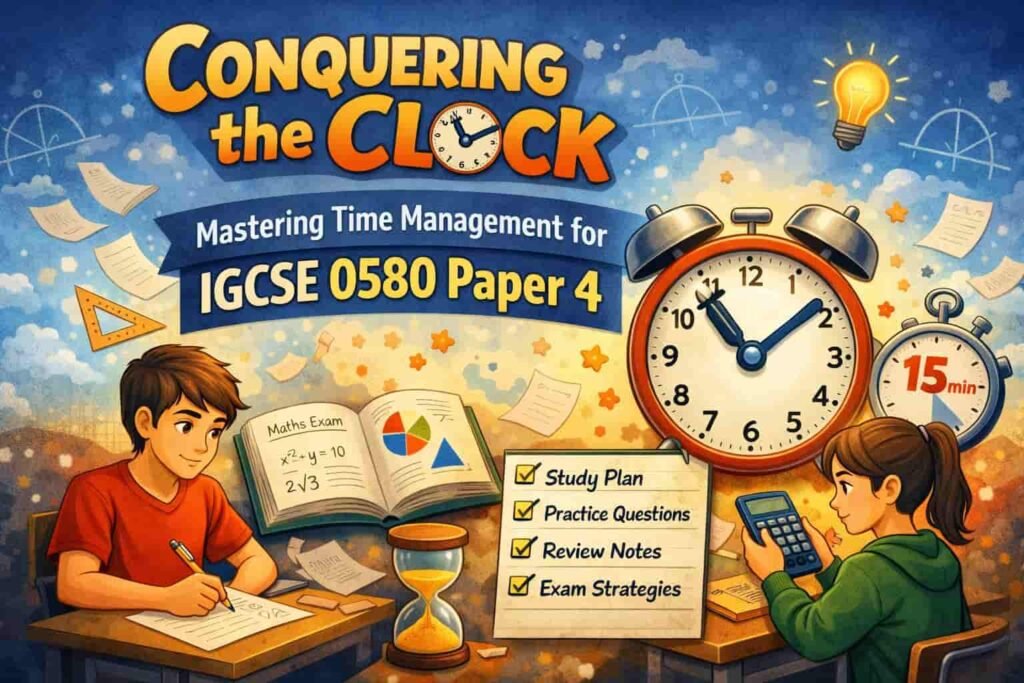
The IGCSE 0580 Mathematics Extended Paper 4 is often viewed as the ultimate hurdle for Cambridge students. With 130 marks to earn in just 2.5 hours (150 minutes), the pressure is palpable. Many learners struggle not because they lack knowledge, but because they run out of time on the heavy-weight, multi-step structured questions.
To secure that elusive A+, you must move beyond simple calculation and embrace a methodical approach to the clock.
1. The “Golden Ratio”: Marks vs. Minutes
Initially, every candidate should understand the math behind the test itself. You have roughly 1.15 minutes per mark. Consequently, a 10-mark question on transformation geometry or algebraic fractions should never consume more than 12 minutes of your focus.
Pro-Tip: If you find yourself stuck on a single 3-mark derivation for more than five minutes, move on. You can always return to it once the high-value “low-hanging fruit” is gathered.
2. Strategic Scanning: Identifying High-Value Targets
Furthermore, Paper 4 is not a race that must be run in linear order. Spend the first 2 minutes scanning the entire booklet.
- Identify Familiar Topics: Look for your strengths perhaps Mensuration, Statistics, or Trigonometry.
- Target the “Long” Questions: These are usually found toward the end and involve complex, multi-part problems. Starting with a topic you enjoy builds immediate confidence and momentum.
3. Precision with Multi-Step Algebraic Manipulation
In addition to speed, accuracy in the early steps of a long question is vital. In IGCSE 0580, a small error in part (a) can sometimes ripple through to part (e).
While “Error Carried Forward” (ECF) marks exist, they are safety nets, not strategies. Write your working clearly. Methodical steps actually save time because they make it easier to spot a mistake during a quick 30-second review.
4. Calculator Efficiency and Scientific Shortcuts
Moreover, your scientific calculator is your best ally—provided you know how to use it. Many students waste precious seconds manually calculating values that modern devices can handle instantly.
- Store Variables: Use the “Memory” keys to save long decimals (like $\pi$ or square roots) to avoid re-typing.
- Table Mode: Use this for function-based questions or finding coordinates for graphs.
- Check Your Mode: Always ensure you are in “Degrees” for SOH CAH TOA problems unless the question specifies otherwise.
5. Managing the “Show That” Questions
Ultimately, Cambridge examiners love “Show That” questions. These provide you with the answer, asking you to prove it. These are gift-wrapped marks!
If your final result doesn’t match the given value, don’t erase everything. Instead, briefly check your signs (positive/negative) and your expansion of brackets. Often, the error is a minor clerical slip rather than a conceptual failure.